Car paint repair in London, carried out at our Greenwich workshop: we put right scuffs, stone chips, scratches and failing lacquer on individual panels, match the colour to your car and cure the finish in a low-bake oven, so the repaired area is hard to tell from the paint around it.
Damaged paintwork is frustrating because you see it every time you walk up to the car. This page explains the paint damage we repair, how we choose between polishing, a SMART repair and a panel respray, and how the colour match, the booth and the oven make the finish last. Bodyteq is a family-run car body repair centre in Greenwich, South-East London, and paintwork sits at the centre of what we do.
Paint damage we repair: scuffs, chips, scratches and lacquer damage
Car paint is built in layers: a primer bonded to the metal or plastic, a colour coat, and a clear lacquer on top that gives the gloss and takes most of the punishment. How we repair the damage depends on which of those layers it has reached, so the first job with any car is to work out how deep the damage goes.
Scuffs and scrapes
A brush against a car-park pillar, a corner that met a bollard, a scrape along a low wall. Most scuffs sit on corners and edges, and many are on plastic bumpers, which are prepared differently from steel panels before they are painted. Damage confined to a bumper is covered in more detail on our car bumper repair page.
Stone chips
Chips gather on the bonnet, the front bumper and the leading edge of the roof, thrown up by the vehicle in front. Each one is a small break through to primer or bare metal, and on a steel panel that exposed metal is where rust can start. A few chips can be touched in; a bonnet peppered with them is usually better refinished. Our stone chip repair page covers chips on their own.
Scratches
A scratch is judged by its depth. A mark you cannot catch with a fingernail is often only in the lacquer; one that shows white, grey or bare metal at the bottom has gone through the colour. Keyed panels, door-edge marks and single deep scratches each have their own section on our car scratch repair page.
Lacquer damage, fading and etching
Not all paint damage comes from an impact. Bird droppings and splashes of fuel can etch into the lacquer if they are left to sit, long spells in strong sun can dull and fade the finish, and older lacquer can cloud, crack or peel away from the colour beneath. Our guide to common paintwork damage problems explains these causes in more detail.
Light etching that sits in the surface of the lacquer can sometimes be polished back. Once lacquer has started to lift, though, polishing cannot bring it back, and the affected panel needs to be prepared and refinished.
Polish, SMART repair or panel respray: choosing the right paint repair
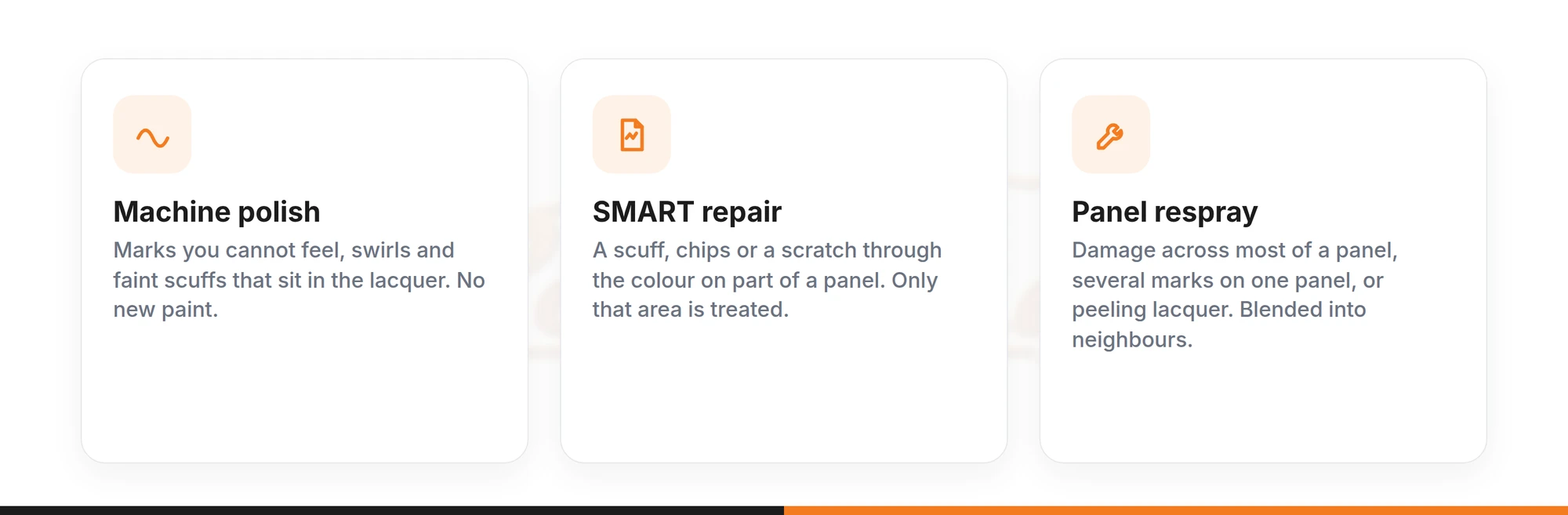
There are three ways to put paint damage right, and the right one is whichever restores the finish with the least intervention. We tell you which your car needs when we quote, and why.
Machine polishing for marks in the lacquer
Fine scratches, swirl marks and light scuffs that sit in the lacquer can often be corrected and polished out by machine, with no new paint at all. It is the quickest and least invasive repair, and it keeps your factory finish. The limit is the lacquer itself: it is only so thick, and we will not polish through it to chase a mark that has gone deeper.
SMART repair for a contained area
When damage has broken the colour coat but is confined to part of a panel, a SMART repair (Small to Medium Area Repair Technology) treats only that area. It is filled where needed, primed, painted, lacquered and cured, then blended into the surrounding paint. Less of the panel is painted, which keeps the job smaller and quicker, and it suits a scuffed bumper corner, a door-edge scrape or a single deeper scratch.
Panel respray blended into its neighbours
When damage covers too much of a door, wing, bonnet or bumper for a localised repair, or several marks are spread across the same panel, we respray the panel. It is prepared, painted with genuine Standox paint and high-solids lacquer, cured in the oven, and the colour is blended into the panels on either side so there is no step in shade along the car.
As a rough guide to which repair your car is likely to need:
- Marks you cannot feel, swirls or faint scuffs: machine polishing.
- A scuff, a cluster of chips or a scratch through the colour on part of a panel: a SMART repair.
- Damage across most of a panel, several marks on one panel, or peeling lacquer: a panel respray.
How we match your colour: paint code, spectrophotometer and blending
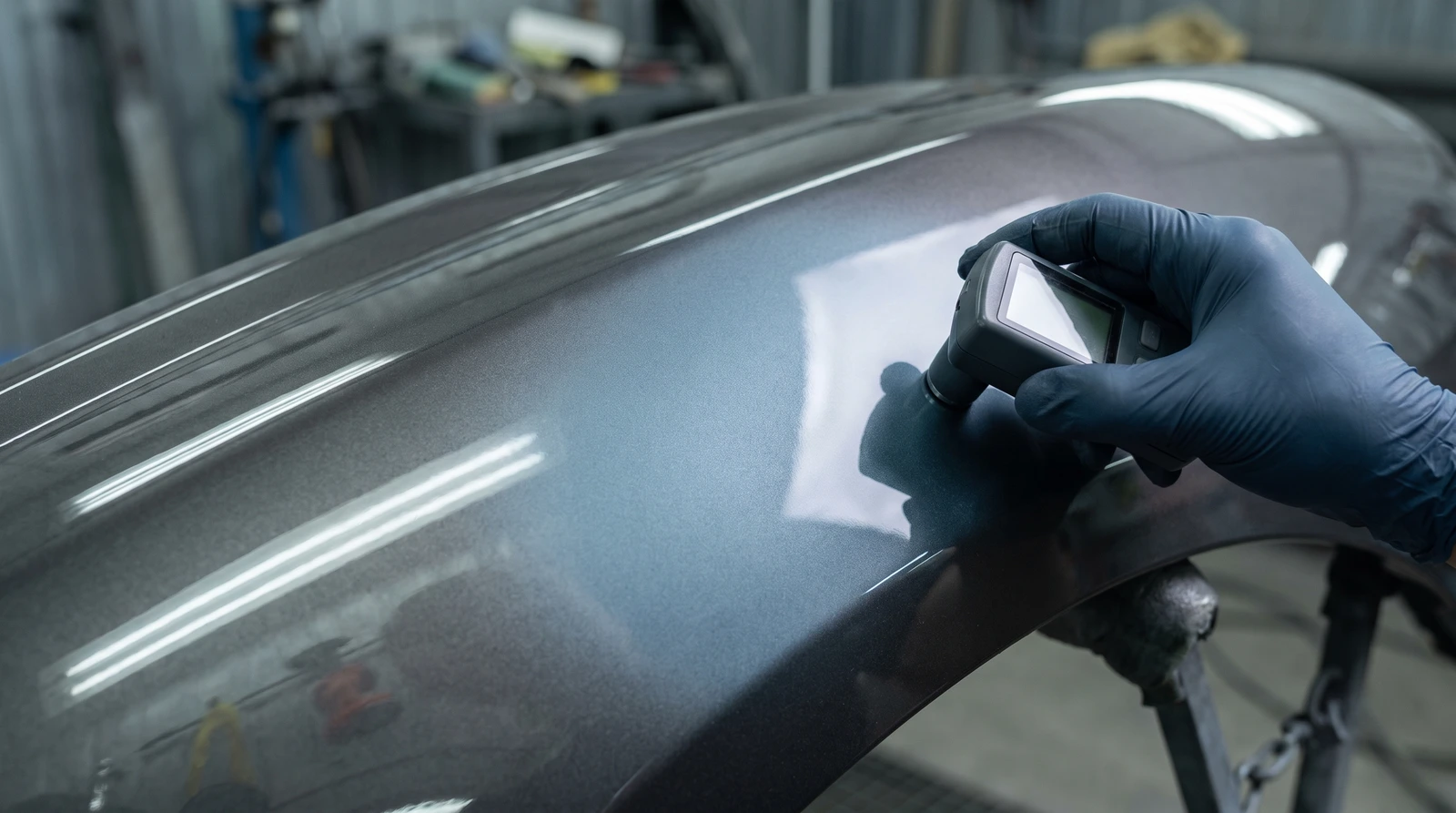
A colour match starts with the manufacturer’s paint code, which we take from the vehicle itself. The code gives the formula your car left the factory with, but it is only a starting point: paint changes as it ages in sunlight and weather, so a mix made purely from the code can come out brighter or cleaner than the panels around it.
So we also read the colour on your actual panels with a spectrophotometer, and the mix is fine-tuned to match the paint as it is now rather than as it was when the car was new. That step matters most on older and sun-faded cars, where the gap between the original formula and the real colour is widest.
Metallic and pearl finishes add another variable. Their sparkle comes from flakes held in the paint, and the way those flakes lie depends on how the paint is applied, so the same colour can look a shade lighter or darker from different angles. These are the most colour-critical finishes we paint, and they are the reason blending matters.
Blending is the final step. Rather than stopping the new colour at a hard line, we fade it into the neighbouring panel or the surrounding paint, then lacquer over the whole area, so the eye has no edge to find. Matching a colour is chemistry; blending it is craft, and both sit with the paint and colour-matching specialists in our team.
Sprayed in a sealed booth, cured in a low-bake oven
Paint goes on wet, and wet paint collects whatever is in the air. Our spray booth is sealed and temperature-controlled, with filtered air coming in and extraction drawing overspray and fumes out, so dust and insects stay out of the finish and the paint is applied in the same conditions whatever the weather outside. Our article on why we paint cars in a spray booth goes into the detail.
After painting, the car moves into our low-bake commercial paint oven. Baking cures the paint and lacquer fully and evenly, so the finish is hard from the start instead of drying slowly at whatever temperature the day allows. A properly cured finish copes with car washes, road salt and sunlight in the same way as the paint around it.
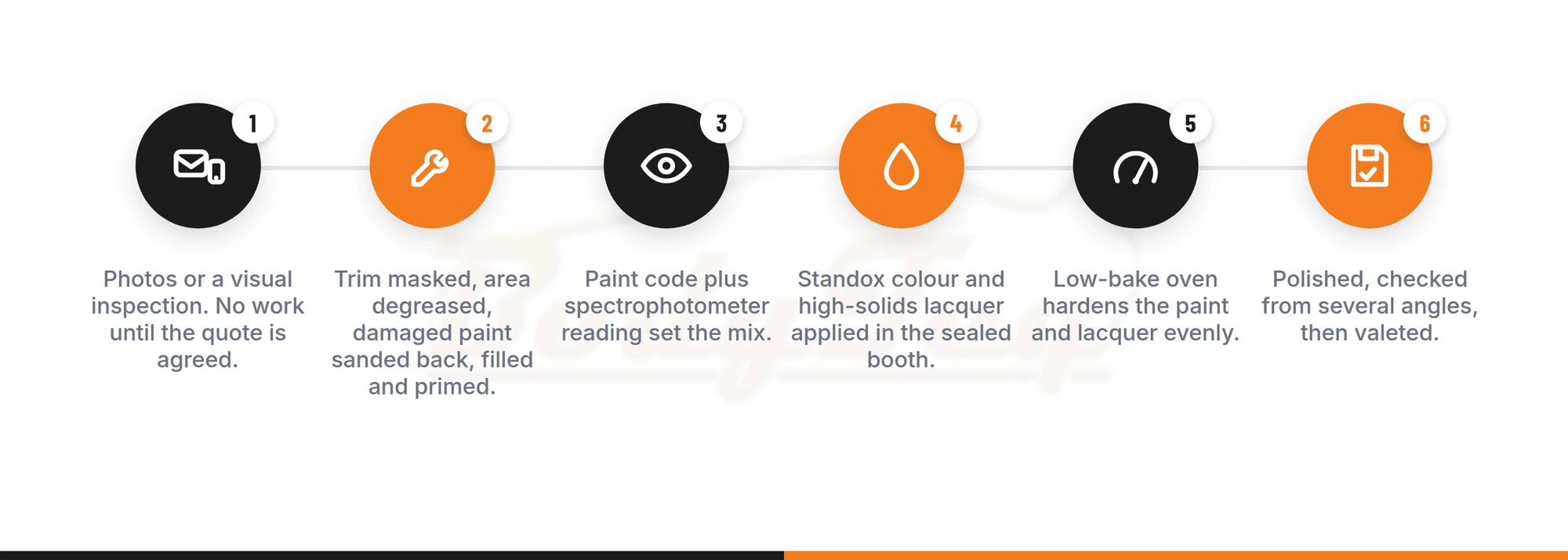
Every paint repair follows the same sequence:
- Estimate. Send clear photos through our contact page for an initial estimate, or bring the car to Greenwich for a visual inspection. No work starts until you have agreed the quote.
- Preparation. Trim and fittings around the damage are removed or masked, the area is cleaned and degreased, and damaged paint is sanded back. Chips and deeper scratches are filled and primed.
- Colour. The paint code and the spectrophotometer reading set the mix for your car.
- Paint and lacquer. Standox colour and high-solids lacquer are applied in the booth.
- Cure. The low-bake oven hardens the paint and lacquer.
- Polish, inspect and valet. The repair is polished, quality-checked under workshop light from several angles, and the car is valeted before you collect it.
Our workmanship is backed by a satisfaction guarantee, and no car leaves the workshop until that final check is passed.
Why a workshop paint repair lasts longer than a roadside one
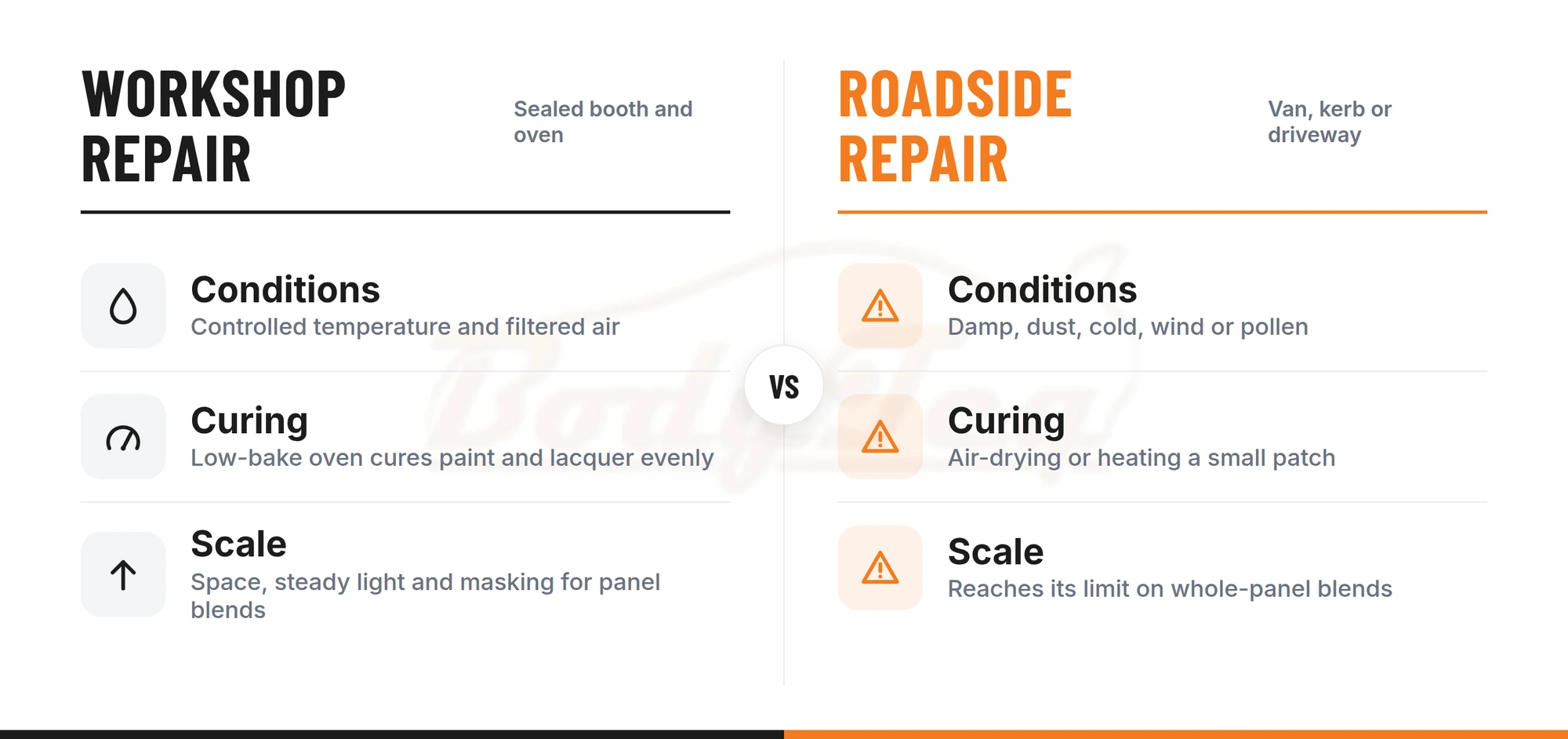
Several of the businesses you will find when you search for car paint repair in London work from a van, at the roadside or on a driveway. For a single light scuff or a handful of chips, that can be a convenient choice. Where a lasting paint finish is concerned, the difference shows in three places.
- Conditions. Outdoors, paint goes on in whatever air there is that day: damp, dust, cold, wind or pollen. In a sealed booth the temperature and airflow are controlled and the incoming air is filtered.
- Curing. Without an oven, a repair relies on air-drying or heating a small patch. A low-bake oven cures the paint and lacquer evenly, so the finish reaches its full hardness before the car goes back on the road.
- Scale. A colour blended across a whole panel, or into the panel beside it, needs space, steady light and proper masking. That is where a localised roadside repair reaches its limit and a panel respray in a workshop begins.
None of this is a criticism of small repairs done well. It is simply why every paint repair we carry out happens at our Greenwich workshop: the booth and the oven stay where they are, so the car comes to them.
How much does car paint repair cost?
Every paint repair is priced on the damage in front of us, because two scuffs that look alike can need very different amounts of work. These are the things that move the price:
- The repair method. Polishing involves the least work, a SMART repair more, and a panel respray the most.
- Size and depth. Damage that stays in the lacquer is quicker to put right than damage through to primer or metal, which has to be filled and primed first.
- Panels and blending. Each panel painted adds to the job, as does any neighbouring panel the colour is blended into.
- The paint itself. Solid colours are the most straightforward; metallic and pearl finishes take longer to match and blend.
- Material and access. Plastic bumpers and steel panels are prepared differently, and some repairs need trim, lights or handles removed to be painted properly.
- Damage underneath. A dent beneath the paint has to be repaired before any colour goes on.
Our quotes are itemised, with no hidden costs, and where a SMART repair will do the job we say so rather than painting more than the damage needs. For typical price ranges in the capital, see our car body repair cost guide for London. If your damage is a scratch, our car scratch repair cost page breaks the price down by depth.
Bringing your car to our Greenwich workshop from across London
Our workshop is in Greenwich, South-East London, and drivers bring their cars to us from across South, South-East and East London and the wider Greater London area, including Blackheath, Charlton, Woolwich, Bexley, Sidcup, Dartford, Bromley and Orpington. You can check your area on our service areas page.
The easiest way to start is with photos. Take a few of the damage in daylight, one close up and one from a few steps back so we can see the whole panel, and send them to us for a photo estimate. We will reply with an estimate and a time to bring the car in, and we confirm the final price once we have seen it, because some damage only shows once trim is removed or the panel is cleaned.
If the paint damage came from an accident, we handle repairs through your insurance. We work with all insurers and deal with yours directly, from the estimate through to authorisation and payment, so you are not paying up front. For minor marks, you may prefer to pay privately and leave your policy untouched; we are happy to quote either way. The claim process is set out on our accident and insurance repairs page.
Car paint repair FAQs
Can you repair car paint without respraying the whole panel?
Often, yes. Marks that sit in the lacquer can usually be polished out with no new paint, and damage confined to part of a panel can be put right with a SMART repair that treats only the affected area. A panel respray is kept for damage that covers too much of the panel, several marks on the same panel, or lacquer that has started to peel.
How do you match the colour of older or faded paint?
We start from your car’s paint code, then read the colour of your actual panels with a spectrophotometer and adjust the mix so it matches the paint as it has aged, not as it left the factory. The new colour is then blended into the surrounding paint so there is no hard edge between old and new.
How long does a car paint repair take?
A small localised repair, such as a bumper scuff or a single scratch, can often be completed in a day or so. A panel respray takes longer, because each stage from preparation to the oven cure has to be finished properly before the next begins. You get a realistic timescale with your quote.
Is a workshop paint repair better than a mobile one?
For a light scuff or a few chips, a mobile repair can be a convenient option. For anything that needs a panel painted, a demanding colour blended or a finish that has to last, a workshop has the advantage: a sealed, filtered spray booth and a low-bake oven that fully cures the paint and lacquer. All of our paint repairs are carried out at our Greenwich workshop.
Can my paint repair go through my insurance?
Yes, if the damage was caused by an accident or another event your policy covers. We work with all insurers and deal with your insurer directly, from the estimate through to authorisation and payment. For wear, weathering and minor marks, we quote you directly.
Paintwork is rarely judged head-on. It is judged from an angle, in low winter sun along the side of the car, which is exactly when a poor colour match or a hazy blend gives itself away. That is why every panel we paint is checked under workshop light from several angles before the car goes home.