Skip to content

Expert Paintless Dent Repairs in London

At Bodyteq, we specialise in Paintless Dent Repair (PDR) to remove dents, creases, and minor dings without the need for fillers, respraying, or invasive techniques. Whether your car has been dented by a careless driver, a shopping trolley, or hail damage, our skilled technicians can restore it to its original condition. Our PDR service is fast, affordable, and retains your vehicle’s factory paint finish—helping you preserve its value and appearance.

Paintless Dent Repairs

Small dent repair in London usually turns on one question you can partly answer yourself: is the paint over the dent still whole? If it is, the dent can very often be worked out from behind with no filler and no paint. If the paint has cracked, or the dent sits on a sharp crease or the edge of a panel, it needs filling and refinishing instead. At our workshop in Greenwich, South-East London, we carry out both repairs, so your car gets the method the dent actually needs.

A fresh ding in a door you keep clean is irritating out of all proportion to its size, and we understand that. The reassuring part is that most small and minor dents can be made to disappear completely. This page explains how to tell which kind of dent you have, what each repair involves, what dent repair typically costs in the UK, and how we handle it from the first photo to collection.

Is Your Dent a Paintless Repair or a Paint Repair?

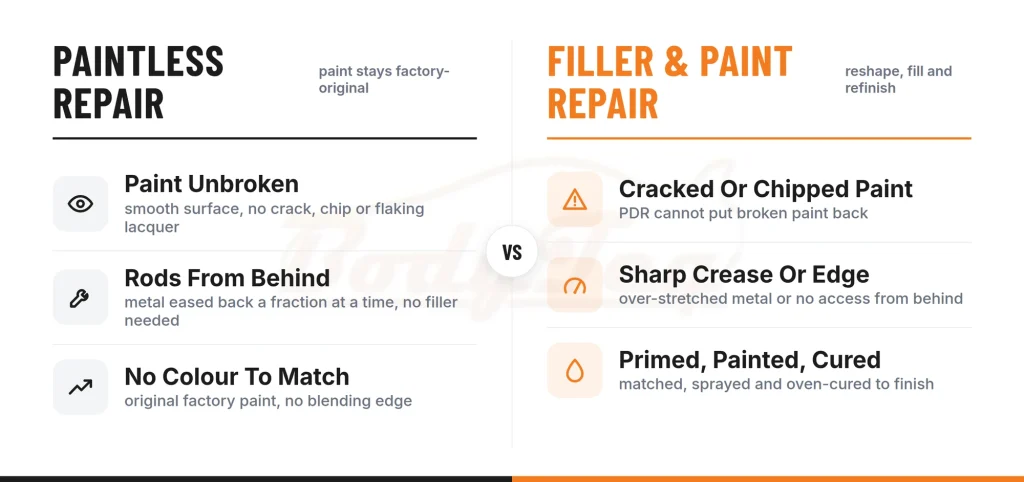
Comparison of paintless dent repair versus filler-and-paint dent repair: unbroken paint and rod access versus cracked paint, sharp creases and oven-cured refinishing

Every small dent we see ends up on one of two routes. Paintless dent repair (PDR) eases the metal back to its original shape and leaves your factory paint untouched. A conventional repair reshapes the panel, fills and smooths what is left, then primes, paints and lacquers it to match. Neither is better in the abstract. What matters is which one the dent will accept.

You can get a good early idea before you contact anyone. Look at the dent at an angle in daylight, then run a fingertip gently across it. Smooth paint and an unbroken reflection point towards PDR. A hairline crack, a chip, flaking lacquer or a sharp ridge you can feel points towards filler and paint.

Dents we remove without paint

  • Car-park door dings: the round, shallow dent another car’s door leaves in a door or wing.
  • Shopping trolley knocks and low-speed nudges that dished a panel without marking the paint.
  • Shallow, rounded creases where the metal has bent but has not been stretched hard.
  • Small dents in a panel we can reach from behind, often by removing a trim panel, a light cluster or a section of interior moulding.

Dents that need filling and refinishing

  • Any dent where the paint has cracked, chipped or started to flake. PDR cannot put broken paint back.
  • Sharp creases with a hard edge, where the metal has been over-stretched and will not return cleanly to shape.
  • Dents on the very edge of a panel or over a bonded seam, where there is no way to get a tool behind the damage.
  • Dents with a deep scratch or scrape running through them, which need paint whatever happens to the metal.

Aluminium panels, fitted to many prestige cars, sit between the two. Aluminium work-hardens and is less forgiving than steel, so we assess those dents case by case. Dents in a plastic bumper are a different job again, because a bumper flexes and is painted plastic rather than pressed metal; those are handled through our car bumper repair service.
How Paintless Dent Repair Works

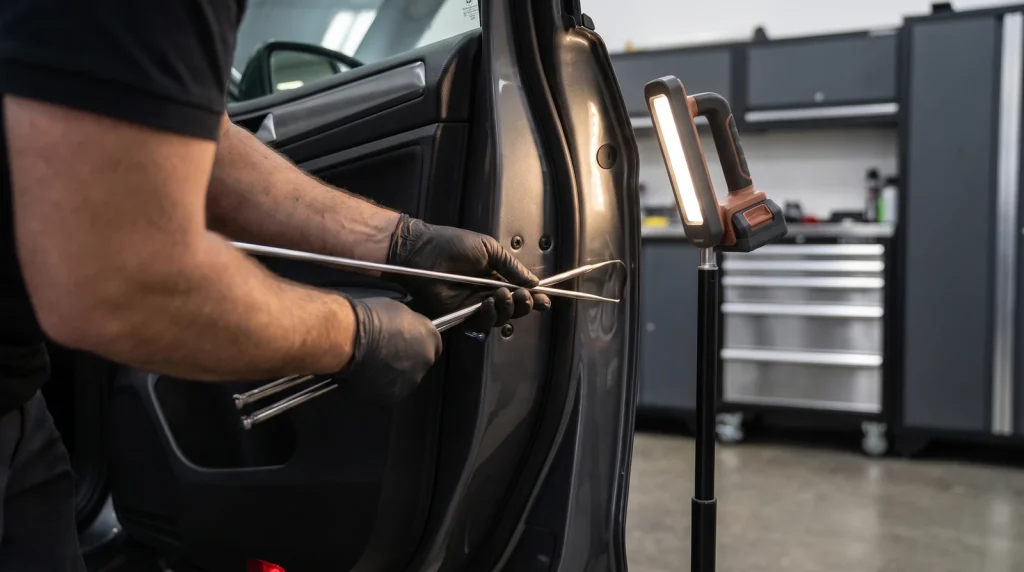
Technician's hands using paintless dent repair rods from behind a car door panel under a workshop inspection light

When a panel dents but the paint stays whole, the paint has stretched with the metal rather than broken. PDR works with that. Our technician gains access to the back of the dent, then uses specialist rods to apply small, controlled pressure at exact points, easing the metal back a fraction at a time until the panel is flat again.

Good light does much of the diagnostic work. Under it, a dent shows as a distortion in the reflection, and the technician reads that distortion to decide where the next push goes. The job is finished when the reflection runs straight across the panel from every angle, not just when the dent looks gone from straight on.

Because nothing is filled or sprayed, the finish you drive away with is your car’s original factory paint. There is no colour to match, no edge to blend and no filler that can shrink or crack later. PDR also needs no oven and no heat, which suits electric and hybrid cars, and no paint, solvents or chemicals are used.

Reading how a particular panel will move is most of the skill, and it takes time to learn. Our technicians bring over 70 years of combined experience across everyday and prestige cars, and the same team carries out the paint repairs when a dent turns out to need them.
When a Small Dent Needs Filler and Paint

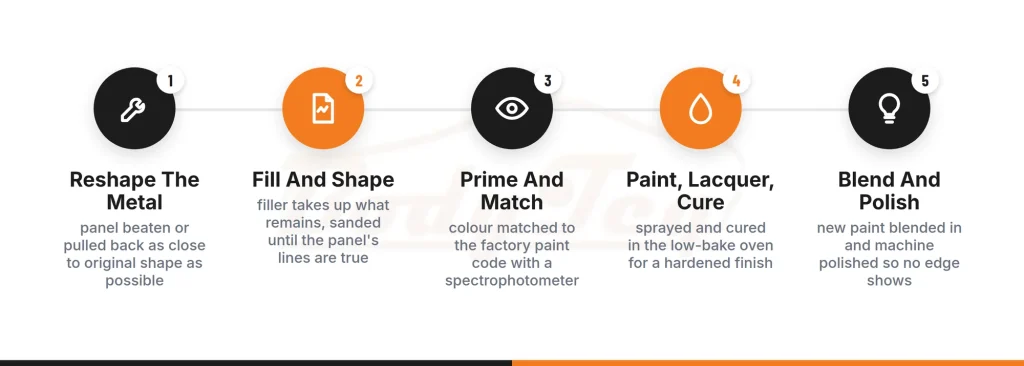
Five-step dent fill-and-paint repair process: reshape the metal, fill and shape, prime and match, paint lacquer and cure, blend and polish

A dent that cannot be pushed out paintlessly still does not have to mean a new panel. Most of these repairs follow the same sequence, carried out in-house at our workshop:

  1. Reshape the metal. The panel is brought back as close to its original shape as possible first, by panel beating or, where there is no access behind it, by pulling from the front. The closer the metal gets, the less filler the repair needs.
  2. Fill and shape. Filler takes up what remains and is sanded until the panel’s lines are true again.
  3. Prime and match. The area is primed, and the colour is matched to your car’s factory paint code using a spectrophotometer.
  4. Paint, lacquer and cure. Genuine Standox paint and high-solids lacquer are applied in the paint booth, then cured in our low-bake oven so the finish hardens fully.
  5. Blend and polish. The new paint is blended into the surrounding panel and machine polished so there is no visible edge.

For a small, localised dent this is often done as a SMART repair, keeping the paintwork to the damaged area rather than refinishing the whole panel. That keeps the job quicker and the cost down, while the oven cure keeps the finish durable.

Pulling from the front is how we deal with a dent that has nothing to push against from behind. On one Fiat Mito dent repair, a lorry had scraped along the side of the car in a hit and run. We fixed small pins to the damaged panel, locked a slide hammer onto them to pull the dent out, and beat the panel back into shape before it was refinished to look as good as new.
How Much Does Small Dent Repair Cost?

We price every dent on the dent in front of us, so the figures below are a guide to the UK market, not Bodyteq prices. They come from published UK dent repair price lists, and some of those lists quote before VAT.

Dent typeUsual repairTypical UK price (guide)
Small single ding, paint intact (car-park door, trolley)Paintless dent repairTypically costs from £75
Small dent, paint intact, where the repairer prices per panelPaintless dent repairTypically costs from £90 per panel
Larger dent, soft crease or several dents on one panel, paint intactPaintless dent repairQuoted after inspection
Dent with cracked or chipped paint, a sharp crease or on a panel edgeReshape, fill, paint and curePriced as a paint repair, quoted after inspection

Minor dent repair cost moves with the size and depth of the dent, how many there are, where on the panel they sit and how easy the back of the panel is to reach. A paintless repair is usually the less expensive route because there is no filler, paint or oven time involved. For how paint repairs and wider bodywork are priced, our car body repair cost guide sets out the detail. Your exact figure comes from a free quote once we have seen the car.

Why Bring a Small Dent to a Workshop?

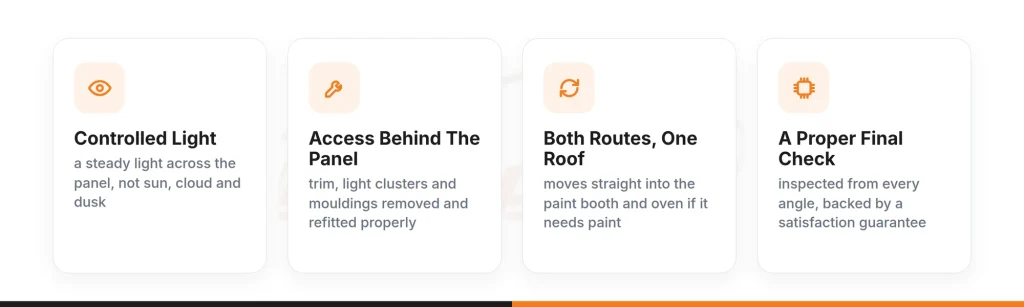
Four advantages of a workshop dent repair: controlled light, access behind the panel, both repair routes under one roof, a proper final check

Search for paintless dent repair in London and much of what comes back is repair carried out outdoors, on a driveway or in a car park. For a simple ding on an easy panel, that can be a reasonable choice. The difference a workshop makes shows up in the dents that are not simple.

  • Controlled light. Reading a dent depends on a steady light across the panel. Indoors we control it, rather than working around sun, cloud and dusk.
  • Access behind the panel. Removing a light cluster, trim panel or interior moulding to reach a dent is straightforward on a workshop floor, and refitting it properly matters as much as the dent.
  • Both routes under one roof. If a dent turns out to have a crack in the paint, or will not come out cleanly, the repair moves into the paint booth and oven on the same visit. There is no second appointment somewhere else.
  • A proper final check. Every repair is inspected from several angles before the car goes back, and our workmanship is backed by a satisfaction guarantee.

Bodyteq is a family-run bodyshop with a fixed workshop in Greenwich, and every dent repair happens there. You bring the car to us, and for many small dents you can simply leave it with us for the day.

How We Repair Your Dent, From Photos to Collection

  1. Send photos or bring the car in. We can give an initial estimate from images, or look at the dent in person at the workshop.
  2. Assessment. We check the size, depth and position of the dent, whether the paint is genuinely intact and what sits behind the panel. Then we tell you which route it needs, paintless or fill and paint, and why.
  3. Quote and timescale. You get a clear quote with no hidden extras, and a realistic timescale, before any work starts.
  4. The repair. Trim or fittings are removed where needed, and the dent is either worked out paintlessly or reshaped and refinished.
  5. Inspection and valet. We check the panel in raking light from every angle, refit anything we removed and valet the car before you collect it.

Most single small dents repaired paintlessly are completed within hours, and many are a same-day or next-day job. A dent that needs paint takes longer because the finish has to be prepared, sprayed and cured, and we tell you that when we quote rather than on the day.

DIY Dent Pullers: When They Help and When They Make It Worse

Glue-pull tabs, suction cups and bridge pullers are sold widely, and on a tiny, shallow ding in the middle of a flat, accessible panel they can take out the worst of it. The trouble starts on anything harder. Pulling from the front concentrates force on the paint surface, which can crack the finish you were trying to save.

It is also easy to over-pull and leave a raised high spot that catches the light more than the original dent did. Once the paint cracks or the metal stretches, a dent that could have been lifted out paintlessly becomes a fill-and-paint job. If the dent is on a body line, on a metallic finish or bigger than a small dimple, it is worth having it looked at before you try a kit.

Small Dent Repair in Greenwich and Across London

A dent’s size says less about the repair than the state of the paint over it. Photos give us a good start, but a proper look under workshop light is what confirms whether your dent will come out cleanly or needs paint, and we would rather tell you that plainly than force the wrong repair.

Drivers bring small dents to us from across South, South-East and East London and the wider Greater London area. If you are in the south-west, our page on car dent repair in Wimbledon covers that area, and you can check the rest on our service areas page.

If the dent came from someone else’s car or an accident and you would rather claim, we handle repairs through your insurance and work with all insurers, dealing with them directly. For damage that goes beyond a dent, see our full car body repair service.

Get your free dent repair quote and bring your car to our Greenwich workshop.

Small Dent Repair FAQs

How much does small dent repair cost?

It depends on the size and depth of the dent, how many there are, where they sit and whether the paint is intact. Paintless repairs are usually the less expensive route because there is no filler, paint or oven time; dents that need filling and paint are priced as paint repairs. We quote once we have seen the dent, from photos or in person, and our car body repair cost guide explains what moves the price.

Can every small dent be removed without repainting?

No. Paintless dent repair only works when the paint over the dent is unbroken and the metal has not been over-stretched. Cracked or chipped paint, a sharp crease, or a dent on a panel edge or bonded seam with no access behind it needs reshaping, filling and refinishing instead. We tell you which your dent needs before any work starts.

How long does small dent repair take?

A single small dent repaired paintlessly is usually completed within hours, and many are a same-day or next-day job. A dent that needs filler and paint takes longer, because the paint has to be prepared, sprayed and cured in the oven. You get a realistic timescale with your quote.

Do you repair dents at my home or workplace?

No. Every dent repair is carried out at our workshop in Greenwich, where we have controlled light, room to remove trim and light clusters, and the paint booth and low-bake oven if a dent turns out to need paint. Send photos for an initial estimate, then bring the car in.

Is paintless dent repair suitable for electric and hybrid cars?

Yes. PDR needs no oven and no heat, so the car never goes near the temperatures a paint cure involves, and no paint, solvents or chemicals are used. If a dent on an electric or hybrid car does need paint, we explain that at the quote stage.

Can my dent repair go through my insurance?

Yes, if the dent is part of an accident or damage you are claiming for. We handle repairs through your insurance and work with all insurers, dealing with them directly from the quote through to authorisation. For a single small dent it is often simpler to pay for the repair yourself, so compare the quote with your policy excess first.

Call us