A stone chip can mean two completely different repairs, and the phrase itself does not tell you which one you need. If the chip is in your windscreen, that is glass work. If it is in your paintwork — a pale dot on the bonnet, marks scattered along the leading edge of a wing, a chip on the bumper that has begun to darken — that is bodywork, and it is what this page is about.
Bodyteq is a family-run body repair workshop in Greenwich, South-East London. We repair chipped and stone-blasted paintwork the way a lasting repair has to be done: prepared back to a sound edge, colour-matched to your car’s exact shade, rebuilt in layers and sealed under fresh lacquer, indoors.
Bring the car in for us to look at, or send photographs and we will estimate from those — get a free estimate or call 0207 998 4712.
Paintwork Stone Chip Repair — Not Windscreen Chip Repair
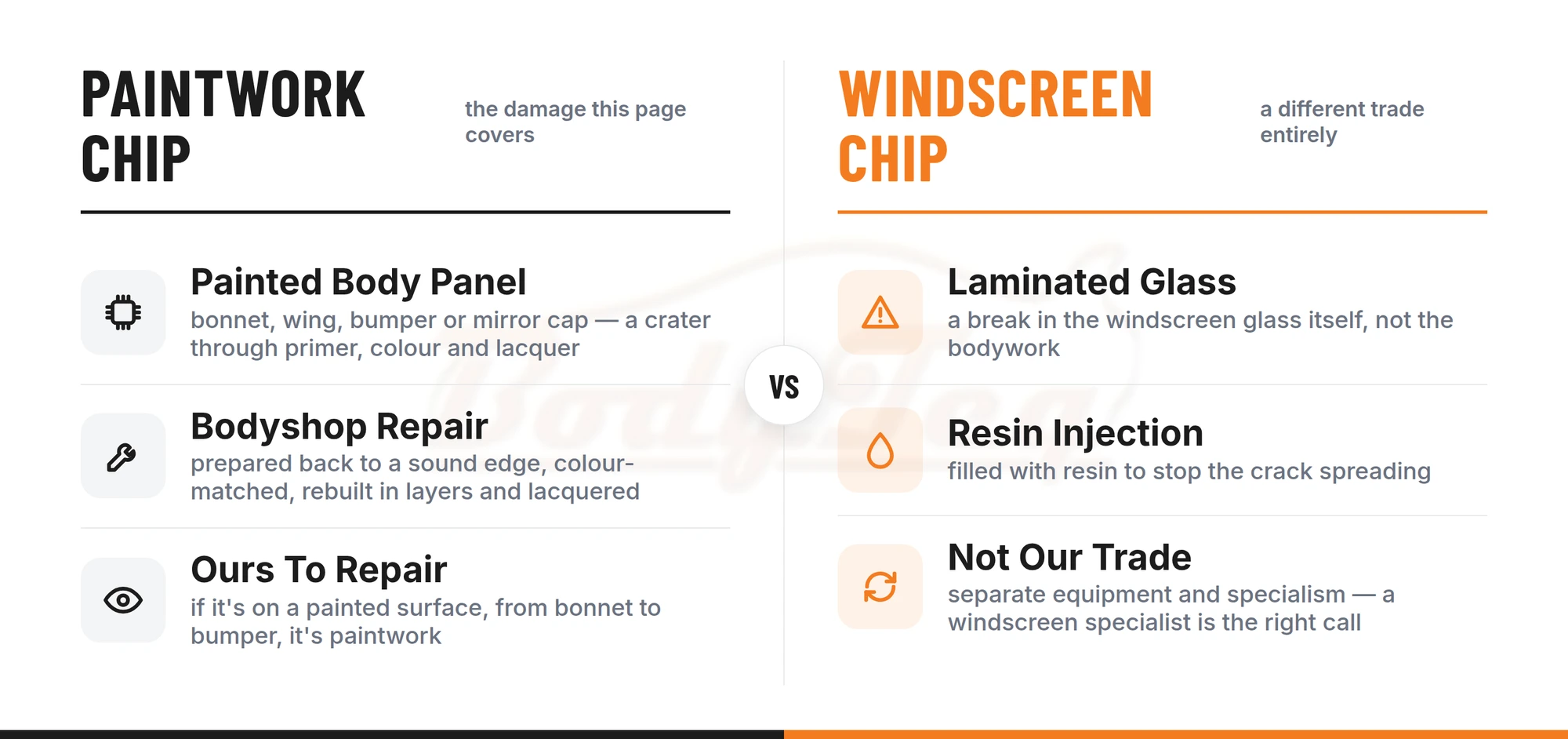
The two jobs share a name and little else. A windscreen chip is damage to laminated glass, put right by injecting resin into the break to stop it spreading — a separate trade with separate equipment, and not work we carry out. If your damage is in the glass, a windscreen specialist is the right call.
A paint chip is damage to a painted panel. Car paint is built in layers — primer over the metal or plastic, the colour coat, then clear lacquer on top — and a stone thrown up at speed punches a small crater through one or more of them. How deep it goes decides everything about the repair. If the chip is on a painted surface, from bonnet to bumper to mirror cap, it is paintwork, and it is ours.
Stone Chip Damage We Repair: Bonnets, Bumpers and Leading Edges
Stone chips do not land at random. They collect where the car meets the air first, which is why the same few areas come through the workshop over and over.
The bonnet is the classic case — chips gathered across the front third and along the leading edge, picked up at speed behind other traffic. Wing tops, mirror caps and the front edge of the roof follow the same pattern. Front bumpers take something different: fine, dense stone-blasting low down, often called road rash, rather than a few distinct chips.
How many chips there are matters as much as how deep they go. One chip, or a handful, is a localised spot repair. A bonnet peppered right across its leading edge is a different conversation, because dabbing at every individual mark is neither the neatest answer nor the most sensible one. We will tell you honestly which of the two your car is.
Chips rarely arrive alone, either. Where the same stretch of road has left scratches as well, we can put both right in one visit — there is more on that side of the work on our scratch repair page.
When a Chip Has Gone Through to Primer, Bare Metal or Rust
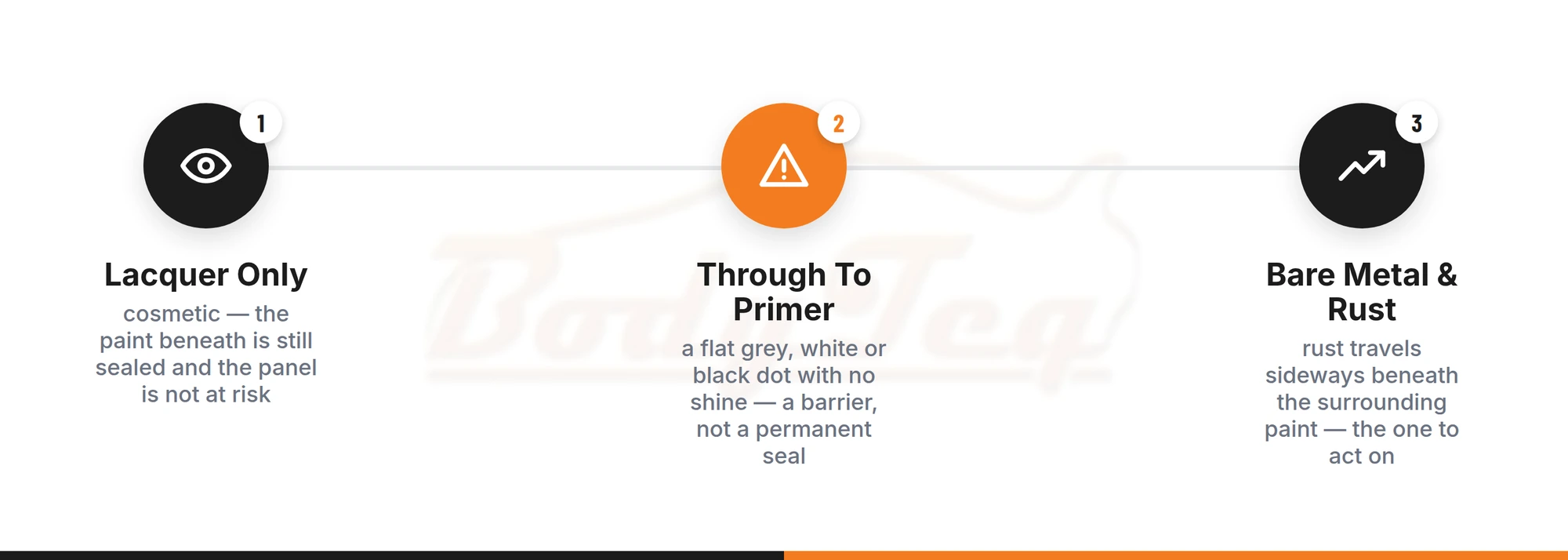
Depth is what separates a cosmetic annoyance from a job that gets worse. A chip that has taken off only the lacquer, or the lacquer and the top of the colour coat, is cosmetic: it looks poor, but the paint beneath is still sealed and the panel is not at risk.
A chip through to primer shows as a flat grey, white or black dot with no shine. The primer is still doing a job, but it is a barrier rather than a permanent seal, and on a steel panel moisture works through it in the end.
A chip through to bare metal is the one to act on. It looks bright at first, then dulls, then browns at the edges. Rust does not stay inside the visible dot — it travels sideways beneath the surrounding paint, which is why a rusted chip so often lifts a patch far bigger than the chip itself. Paint will not stick to rusty metal, so covering it over only seals the problem in. The repair is to take the corrosion back to clean, sound metal, prime it, and rebuild the colour and lacquer over the top.
Panels differ. Plastic bumpers do not corrode, so a deep chip there is a finish problem rather than a structural one. Aluminium, common on newer and prestige cars, does not rust in the familiar orange way but blisters under the paint instead, and it needs the correct materials and method — one of the reasons we work to Thatcham Approved OE repair methods rather than a single blanket approach.
DIY Paint Chip Repair Kits vs a Professional Repair: an Honest Comparison
Touch-up kits are not a con, and it would be dishonest to pretend they are. On the right chip they do a genuinely useful job.
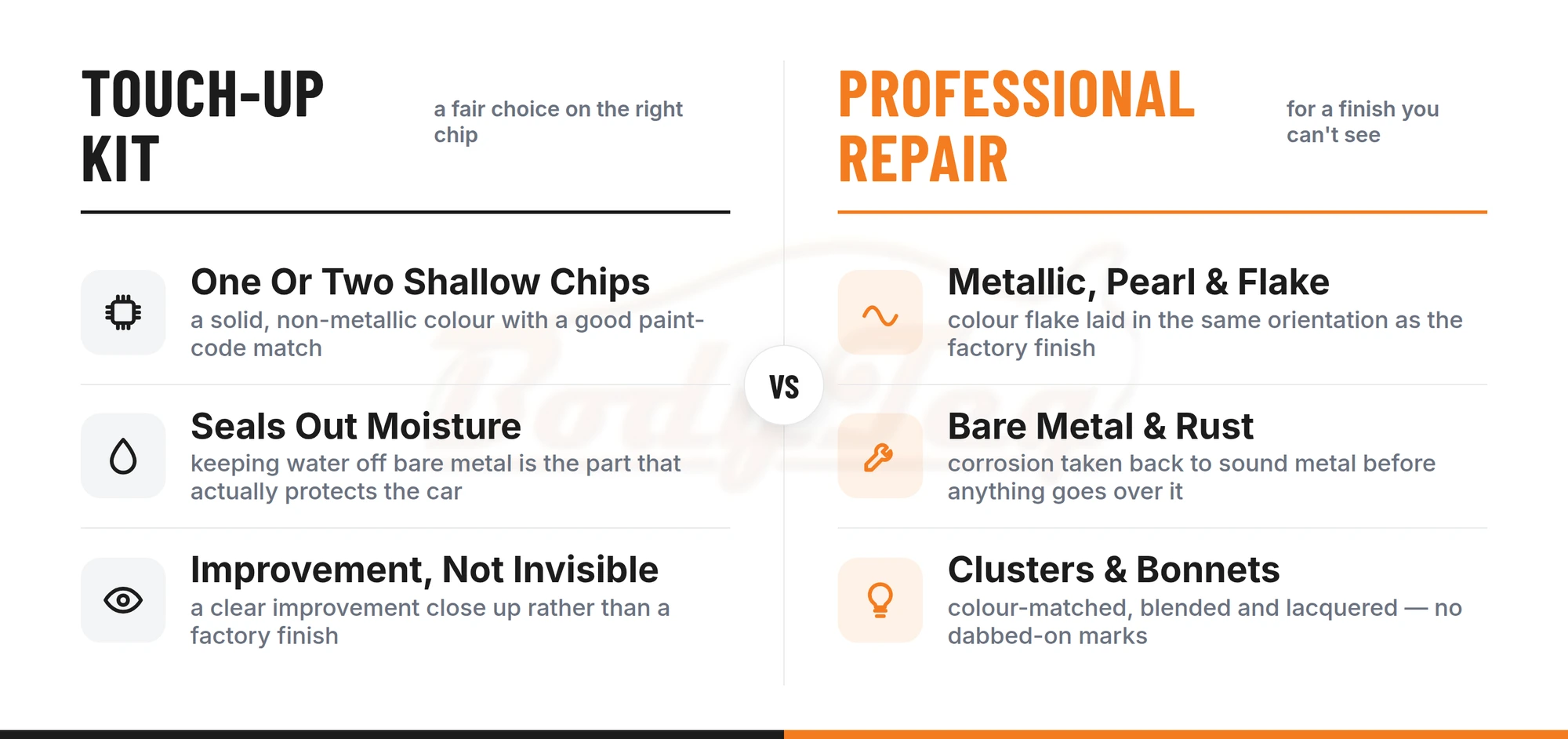
A kit is a fair choice when the damage is one or two shallow chips, the colour is a solid non-metallic shade, the paint code matches well, and you will be content with a clear improvement close up rather than an invisible repair. Sealing a fresh chip against moisture is worth doing even if the finish is imperfect — keeping water off bare metal is the part that actually protects the car.
Four situations are where kits come unstuck, and they are the ones we tend to see after the fact. Metallic, pearl and three-stage colours are the first: touch-up paint cannot lay metallic flake in the same orientation as the factory finish, so the repair dries darker and flatter and reads as a dark spot in daylight. Chips already into bare metal or showing rust are the second, because the corrosion has to come out before anything goes over it. Clusters are the third — dozens of individually dabbed chips look worse from three paces than the chips did. A bonnet is the fourth: a flat horizontal panel you look down on in full light is the hardest place on a car to hide an imperfect repair.
The dividing line is straightforward enough. If you want the damage sealed and are relaxed about the finish, a kit has its place. If you want the panel to look as it did before, that is colour-matching, blending and lacquer work, and it belongs in a booth.
How We Repair Stone Chips at Our Greenwich Workshop
Chip repair is localised work by nature, which puts it in the same family as our SMART repair service — repairing only the damaged area instead of refinishing a whole panel. The work runs in four stages.
It starts with an estimate, taken either from photographs you send us or from a proper look at the car here. Chips are easy to underestimate from a phone picture, so where depth or rust is in question we would rather see the panel. The repair is then carried out to OE specification using Thatcham Approved methods: the chip prepared back to a sound edge, any corrosion removed, and the area primed so what follows has something stable to key into.
Then paint. We colour-match to your car’s paint code and its factory variant rather than to the code alone, because one code can carry several variants and paint fades in service. The colour is built up in layers, blended into the surrounding paintwork so there is no visible edge, sealed under a high-solids lacquer and cured in our low-bake commercial oven. We use genuine Standox paints and premium systems including DeVILBISS and 3M PPS.
Last is inspection and finishing — the repair flatted and polished back so it sits level with the lacquer around it, checked in workshop light, and the car valeted before it comes back to you. Where the chips turn out to be the least of a panel’s problems, the work moves into our wider car body repair service instead.
Why an Indoor Workshop Repair Outlasts a Kerbside Touch-In
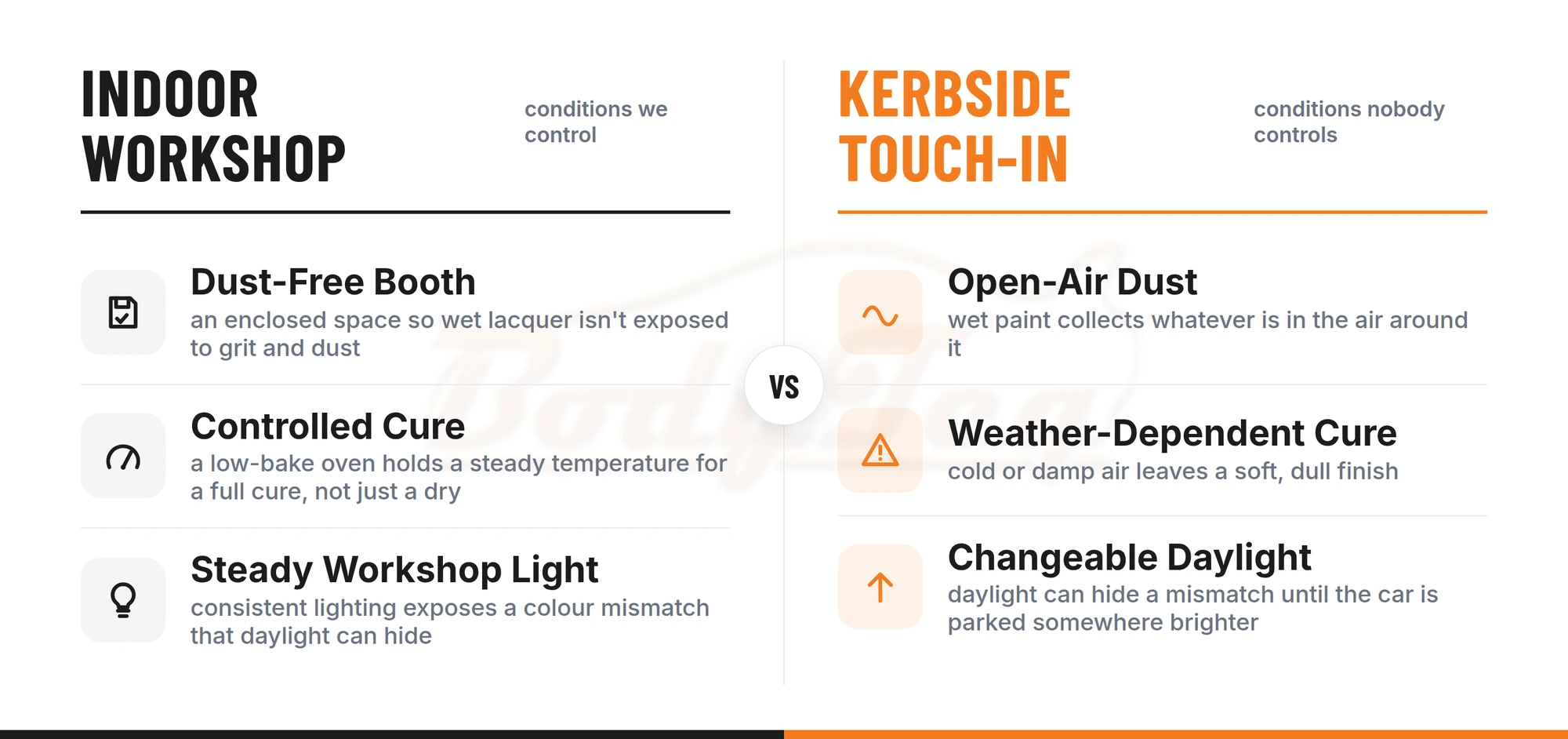
Paint is unforgiving about the conditions it goes on in, and that is the real difference between a repair carried out indoors and one done at the kerb. Dust comes first: wet paint and lacquer collect whatever is in the air around them, and a chip repair is small enough that a single piece of grit landing in it is the whole repair. An enclosed booth removes that risk.
Temperature and humidity come second. Lacquer needs to cure rather than merely dry, and cold or damp air leaves a soft, dull finish that will not see out a winter. A low-bake oven holds the panel at a steady temperature for a controlled cure, which is what gives the repaired area the same hardness and gloss as the paint around it.
Light comes third. A colour match is judged by eye as well as by code, and steady workshop lighting exposes a mismatch that changeable daylight will happily hide until the car is parked somewhere brighter. None of those three conditions travels, which is why we work from a fixed workshop and ask you to bring the car to us.
Stone Chip Repair for South-East London Drivers
London is hard on paintwork in a particular way. Queueing close behind other traffic, the constant patchwork of resurfacing and loose chippings, and long dual-carriageway runs in and out of the south-east all point in the same direction: damage to the front of the car.
We are based in Greenwich, SE10, and drivers bring cars to us from across South, South-East and East London — Blackheath, Charlton, Woolwich, Surrey Quays, Limehouse and West India Quay nearby, with Bexley, Sidcup, Bromley, Orpington, Dartford, Balham and Wimbledon a little further out. You can check we cover where you are on our service areas page.
The arrangement is simple: bring the car to the workshop for us to look at the chips and estimate the work, and the repair is carried out here, where the paint facilities are.
If your bonnet is starting to look peppered, or a chip has darkened at its edges, have it seen before the weather gets into it. Get a free estimate or call us on 0207 998 4712.
Stone Chip Repair FAQs
Can a stone chip be repaired, or does the whole panel need respraying?
In most cases a stone chip is repaired locally rather than by respraying the whole panel. We prepare the chip, colour-match your car’s paint, build it back up in layers and seal it under lacquer. Only widespread chipping across a panel, or damage that has spread beneath the surrounding paint, calls for a full panel repair.
Is this the same as windscreen chip repair?
No. We repair chips in your car’s paintwork — bonnets, bumpers, wings and leading edges. Windscreen and glass chips are a different trade and are not something we carry out. If your chip is in the glass rather than the paint, a windscreen specialist is who you need rather than a bodyshop.
My stone chip has gone through to bare metal and started to rust. Can it still be repaired?
Yes, but it needs treating properly rather than covering over. Paint will not stick to rusty metal, so the corrosion has to be taken back to sound metal, primed, and the colour and lacquer rebuilt over the top. The longer a rusted chip is left, the further it spreads underneath the surrounding paint.
What affects the cost of a stone chip repair?
How many chips there are, how deep they go, whether the metal underneath is exposed or has begun to rust, which panel is affected, and how demanding the colour is to match. A single shallow chip on a wing is a smaller job than a rusted cluster across a bonnet. Bring the car in, or send us photographs, for a free estimate.