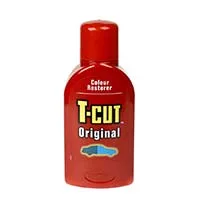
Reach for T-Cut on the right kind of scratch and it works. The light scuffs, swirl marks and dull, oxidised paint that most everyday cars pick up will genuinely come back with it — used properly. Reach for it on the wrong kind of damage, though, and at best you waste an afternoon, at worst you thin the paint further. The whole trick is knowing which scratches T-Cut can touch and which it can’t. Here is how to use it correctly, step by step, and exactly where to draw the line.
What T-Cut actually is — and what it does to your paint
T-Cut is a mild cutting compound, sometimes called a rubbing compound or a colour restorer. It is faintly abrasive: rubbed over paintwork, it shaves away an extremely thin, microscopic layer of the surface. That is the whole mechanism. By levelling off the very top of the paint, it brings a shallow scratch or scuff down to the same level as the paint around it, so the mark effectively disappears. At the same time it lifts oxidation and ingrained grime, which is why tired, faded paint often looks noticeably brighter once you have worked it in.
The important thing to understand is that T-Cut is not a filler. It does not pack a scratch out with anything — it removes paint until the scratch is gone. That works beautifully on marks sitting in the very top layer, but it also means there is a hard limit to how deep it can reach before you simply run out of paint to remove. Modern clear coats are thin, so a little goes a long way, and restraint matters.
Which scratches can T-Cut actually fix?
Before you open the bottle, run a fingernail lightly across the scratch. If your nail glides over it without catching, the damage sits in the clear coat or the top layer of paint — and that is exactly what T-Cut is made for. Light surface scratches, car-park scuffs, swirl marks and dull, oxidised paint all fall into this group, and these are the marks the vast majority of drivers are actually dealing with.
If your nail catches in the scratch, it has cut deeper — through the clear coat and into the colour, the primer, or down to bare metal. T-Cut will not fix that. No amount of rubbing brings back paint that has been gouged out, and pushing harder only thins the healthy paint around the scratch or, worse, breaks through to the metal. Deep scratches, key marks and cracked or flaking paint are beyond what any cutting compound can do — more on those below.
How to use T-Cut on a car, step by step
Once you have confirmed the scratch is shallow enough, the method itself is simple. Work through it slowly and check your progress often — with T-Cut, patience beats pressure every time.
- Wash and dry the panel first. Clean and dry the area thoroughly before you start. Any grit or dust left on the surface will drag under your cloth and put fresh scratches in the paint as you rub — so a proper wash and dry is not optional.
- Work in the shade, on cool paint. Do the job out of direct sunlight and on a cool panel. Hot paint makes the product dry and flash off too quickly, which makes it harder to work and harder to buff away cleanly.
- Apply a small amount to a clean microfibre cloth. Put a small amount of T-Cut onto a clean, slightly damp microfibre cloth or applicator pad — never straight onto the paint. Make sure the cloth has not been dropped on the floor, as trapped grit will scratch the panel.
- Rub the mark with small circular motions. Work the T-Cut into the scratch or dull area with firm, small circular motions. Do not be alarmed if a little colour transfers onto the cloth — that is just the top layer of paint lifting, which is how the mark is being removed.
- Buff off the residue before it dries. Keep checking your progress, and buff the residue off with a second clean cloth before it dries. Left to dry, the compound becomes stubborn to remove, and you want to see clearly whether the scratch has actually gone.
- Repeat if needed — but know when to stop. If the mark is still faintly visible, repeat with a fresh, light application. Stop the moment the scratch has gone, or if you see colour transfer beyond a light haze — that is the sign you are cutting into healthy paint and should go no further.
- Finish with polish and wax to protect the paint. Because T-Cut strips the protective layer as it works, seal the area afterwards. A coat of polish and then wax protects the freshly cut paint and stops it dulling or oxidising again.
Tips and common mistakes to avoid
The most common mistake is using too much product and rubbing too hard. T-Cut removes paint every single time you use it, so the aim is the least cutting that clears the mark — not the most. Work a small area at a time, keep checking, and stop the instant the scratch disappears.
A few other things catch people out. Never let the residue dry on the paint — buff it off while it is still slightly damp. Always use a clean microfibre cloth, because a cloth that has been on the floor carries grit that scratches as you rub. And never use T-Cut on a matte, satin or wrapped finish: it is designed to cut and polish gloss paint, and it will permanently ruin a flat finish. On modern cars with thin clear coats, err on the side of gentle — you can always do a little more, but you cannot put paint back.
When T-Cut isn’t the answer
T-Cut is a genuinely good short-term fix for light, cosmetic marks, but its limits are clear. Anything that has gone through the clear coat needs colour and lacquer putting back — something a cutting compound simply cannot do. Deep scratches, key scratches down to the primer or metal, cracked or flaking paint, and dents all need proper repair rather than a rub with a cloth. Left exposed, a scratch that reaches bare metal can also begin to rust, so it is worth acting sooner rather than later.
If the damage is beyond what T-Cut can reach, that is the point to bring in a professional. Our family-run Greenwich workshop colour-matches and refinishes scratches so the repair is genuinely invisible rather than merely masked — so if a mark has you reaching for the T-Cut a second and third time without success, let our Greenwich workshop repair deeper scratches instead. If you are not sure how deep your scratch really is, our guide on judging car paint scratch depth walks you through the difference.
T-Cut FAQs
Does T-Cut scratch remover really work?
Yes, on the right damage. Because it gently abrades the surface, T-Cut removes light scratches, scuffs and oxidation that sit in the clear coat or top layer of paint, and it restores colour and shine to dull paintwork. What it cannot do is repair anything deeper than that top layer — so it works well on shallow marks and not at all on deep ones. The fingernail test is the quickest way to tell which you have.
Will T-Cut remove key scratches?
Usually not. A key scratch almost always cuts through the clear coat and into the colour or the primer, which is too deep for a cutting compound to reach. Rubbing harder only thins the paint around it or exposes bare metal. Key scratches need the colour and lacquer rebuilding, which is a professional repair rather than a DIY one.
What works better than T-Cut for scratches?
It depends on the depth. For very fine swirl marks and haze, a dedicated polish or a machine compound followed by a finishing polish gives a more controlled result. But for any scratch that has broken through the clear coat, nothing you rub on by hand will fix it — the paint has to be built back up and refinished, which is bodyshop work.
Is T-Cut safe to use on car paint?
Yes, when it is used correctly and on the right finish. It removes a fraction of paint each time, so it is fine used occasionally on healthy gloss paint, but avoid overworking a single spot and go gently on modern, thin clear coats. Never use it on matte, satin or wrapped finishes — it is made to cut and polish gloss, and it will permanently damage a flat wrap. Work in a ventilated spot and wear gloves, as the label advises.
Can I use T-Cut on plastic headlights?
It can help. T-Cut’s mild cutting action lifts the cloudy, oxidised film that builds up on plastic headlight lenses, which improves clarity and light output. Clean the lens first, work the product in gently, then protect the surface afterwards, as bare polished plastic will haze up again over time if it is left unsealed.

Hi. We have a gallon of original T-cut that has thickened some over the years, what can it be thinned with?
Thank you, John
Hey John
Thanks for reaching out to us. Your enquiry has been forwarded to the relevant department and they will be contacting you soon.
Regards
BODYTEQ
My wife’s blue car accidently brushed against the rear nearside bumper of my silver car. There was no denting but Blue paint is visible in the minor scratches. I consulted Halfords who examined the damage and Recommended 3 in 1 T-cut Color Fast. I have made three Attempts to remedy in Accordance with the instructions on the bottle but without success, the faint blue marks remain! Please advise?
Hey Derrick!
Thanks for reaching out. Your enquiry has been forwarded to the relevant department & they will reach out to you soon via email.
Regards
BODYTEQ